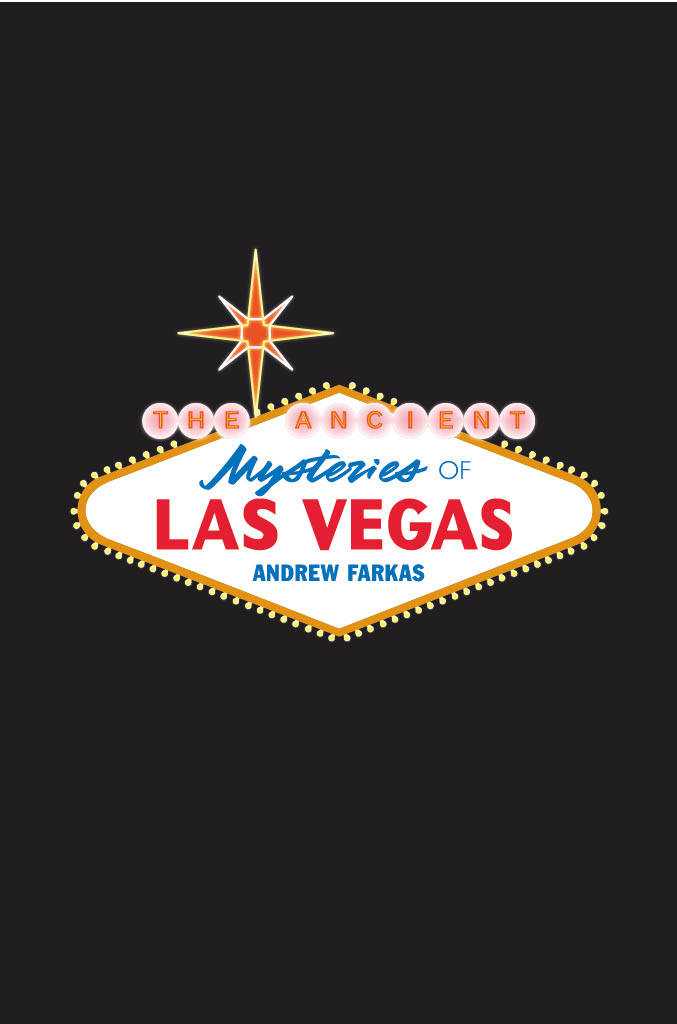
The Ancient Mysteries of Las Vegas
(KERNPUNKT Press 2026)
Throughout the course of The Ancient Mysteries of Las Vegas, we are asked to question whether the events of each act happened in some form at some time to the protagonists, Arty and Auggie, or if those events were dreams of a sort, or, by the third act, if those events are being used by Arty to cover up some deeply private shame and regret. After all, in the first act, Arty and Auggie, two twentysomethings who appear to be trapped in an apartment, imagine a surreal road trip to Las Vegas. But are they dreaming, or are they actually on their way? In the second act, Arty and Auggie, two fortysomething gangsters on the lam in Las Vegas, hide out in a hotel room where they interact with an animatronic boss who keeps promising to bring them a job. Fueled by paranoia thanks to the television, Auggie isn’t even certain when they became gangsters, or how. Instead, Auggie thinks there’s some kind of setup going on. Arty’s not so sure. In the third act, Arty is a very old man, likely in an assisted living facility in Nevada, who thinks he’s in a play. Arty, somehow in his twenties again, is in the audience of the play. Except how could he be in the audience when we learn that he probably died when he and Arty went in search of a legendary place that does not exist (like Atlantis) called Las Vegas? Dealing with memory, fantasy, conspiracist thinking, and friendship, Andrew Farkas’ debut play shows that what happens in Vegas may not stay in Vegas. And what happens when all that surreality bleeds out?
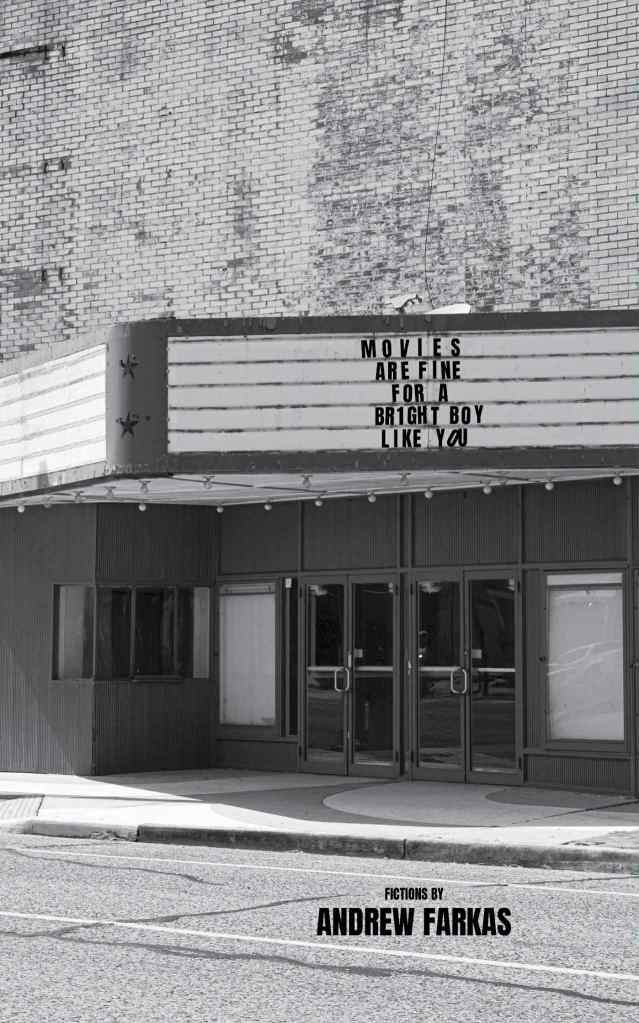
Movies Are Fine for a Bright Boy Like You: Fictions
In the short fiction collection Movies Are Fine for a Bright Boy Like You, Andrew Farkas explores the unseen lives of stock characters (security guards in “Watching the Night” and the two guys who carry a pane of glass across the street during chase sequences in “Mythos of the Glaziers”), examines cinematic conventions (absurd swashbuckling set pieces in “Conditional Vengeance” and the fact that pictures taking place in other countries are full of characters who speak English with bad accents in “[Foreign] Accents”), deconstructs film genres (the thriller in “A Suitcase of Money Out on the Edge of Town” and creature features in “Our Inner Kaiju”), while, along the way, lovingly making fun of almost everything having to do with movies (extras in “A Real Nobody” and purposefully schlocky B-grade horror films in “Continuity”). So grab some snacks and get ready to yuck it up with the rest of the peanut gallery as Farkas celebrates the joyfully, wondrously synthetic history of the movies.
The Big Red Herring
(KERNPUNKT Press 2019) (Amazon) (Bookshop)
In this latest work by Andrew Farkas, the United States and the Soviet Union were allies, not enemies. The moon landing was a hoax filmed by Stanley Kubrick. The Space Race and the Cold War were diversions enacted to cover up the biggest secret ever kept.
But Wallace Heath Orcuson (Wall to his friends) has more immediate problems to deal with. He’s just woken up in an apartment he’s never seen before. There’s a dead body under his couch. It’s his girlfriend’s husband, a man named “Senator” Kipper Maris.
Meanwhile, at a donut shop, a radio narrator, who’s been forced to adopt the name Edward R. Murrow, reads Wall’s story. He hates it. He wants to change it. The problem: Murrow is a narrator, not a writer, and the penalty for altering a manuscript is death. Luckily for Murrow, his boss, “Senator” Kipper Maris, was recently murdered. So maybe no one will notice. Or maybe there’s a reason for the rule.
But you can’t find out what’s in Pandora’s box until it’s opened, right?
Who wants to see what’s inside?
Review by Publishers Weekly
Sunsphere
(BlazeVOX [books] 2019) (Amazon) (Bookshop) (SPD)
The Sunsphere is a 266-foot-tall green truss structure topped by a gold glass sphere that was built as the symbol of the 1982 World’s Fair (also known as the Knoxville International Energy Exposition). Actually, the Sunsphere stands 6,520 feet tall and is composed of a black, cylindrical base capped by a miniature neutron star. Well, the Sunsphere Shot Tower, made entirely of brick, manufactures shot for shotguns. But then, the Sunsphere is 1,000 feet tall and composed of a green tower and a pulsing orb of blue lightning. Really, the Sunsphere is dilapidated, covered in tarps, and likely to be torn down soon. Or maybe, Sunsphere Ziggurat is a massive conceptual art installation constructed by an underground organization called the KnoxVillains. Certainly, Sunsphere, a collection of nine formally innovative fictions, focuses on characters obsessed with ideas of energy and entropy, focuses on characters who are trying to figure out how to continue on in a world that is falling apart, who are trying to learn how to act in a world that is constantly changing. In the face of social collapse, some characters find solace in the logic of puzzles, in the conventions of art, in outdated ideas of empire and romance, in the lure of pop culture, in academia and politics. But at the core of this collection is a search for humanity, even when the very atmosphere appears to demand the inhumane.
Review by Paul Albano in Heavy Feather Review
Review by Michael Czyzniejewski in Story366
Review by Lindsay Ball in Call [Me]

Self-Titled Debut
(Subito Press 2009) (Amazon)
Michael Martone
Author of Michael Martone and The Blue Guide to Indiana
Review by Michael Czyzniejewski in Story366
 Andrew Farkas